
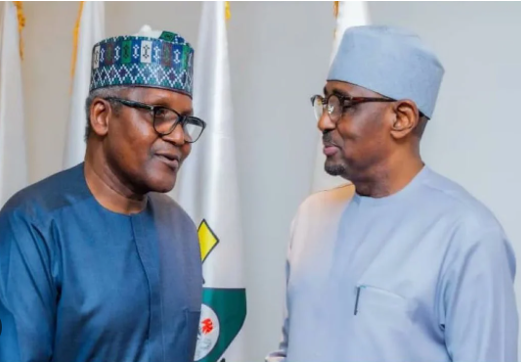
Founder and President/Chief Executive of the Dangote Group, Aliko Dangote, has accused the Chief Executive Officer of the Nigerian Midstream and Downstream Petroleum Regulatory Authority (NMDPRA), Farouk Ahmed, of corruption, alleging that he spent $5 million on secondary school education for his children in Switzerland.
Dangote made the allegation on Sunday during a media briefing at the Dangote Petroleum Refinery and Fertiliser Plant, Lekki, Lagos, describing the alleged expenditure as inconsistent with a public servant’s income and a threat to public trust in regulatory institutions.
Dangote said the alleged payment covered six years of secondary education for four children, an amount he argued could not reasonably be explained by earnings from public service.
“I’ve had people actually complaining about a regulator who put his children in secondary school, and that secondary school education, which is six years, four of them cost Nigeria five million dollars.
“My children went to secondary school in Nigeria. They did not go outside Nigeria to attend secondary school,” Dangote said.
Dangote said taxpayers deserve accountability and questioned why a public official could afford to spend millions of dollars on his children’s foreign education if public funds were being properly used.
“This is a system where some of us are taxpayers. When people are complaining, we also complain, because when I pay tax, I want to see my money put to use, not stolen.
“I don’t know why the authority chief executive, Mallam Farouk, has four children educated in Switzerland at the cost of five million dollars for their secondary school education alone, not university,” he alleged.
The billionaire said the alleged expenditure raised serious concerns about income declaration, conflicts of interest, and regulatory integrity in the downstream petroleum sector.
Dangote said Ahmed should not be immediately dismissed from office but must first be investigated by relevant authorities to clear his name. He further warned that he would take legal steps to compel disclosure if the allegation was denied.